


Store
Each student puts their phone inside the FONOF pouch before entering school.

INSTITUTIONAL PROGRAMS
CELOUT is a program for implementing phone-free spaces in schools. Our special pouch, featuring French technology, prevents the phone from being removed without the unlocking device and is designed to block Bluetooth and mobile network signals. Each student keeps their phone with them at all times, but cannot use it while the pouch remains locked.
Access is governed by clear rules.
HOW IT WORKS IN YOUR SCHOOL
Each student puts their phone inside the FONOF pouch before entering school.
The student closes the pouch and keeps it during classes and breaks. They cannot open it on their own.
Students open their pouches with the unlocking device when leaving school. Your school defines exceptions and emergency procedures.
CELOUT has designed four plans so you can choose the most suitable option for your educational institution.
The ideal option to obtain our best discount. Contract the program before importation with an initial deposit and pay the balance when implementation of the program at your educational institution is complete.
Ask about pre-ordersThe ideal option for schools that need to implement the program as quickly as possible. It includes delivery of pouches, unlocking devices and support to get the entire program running at your educational institution.
Ask about immediate purchaseThe ideal option for schools that prefer to implement the program through monthly rental payments, according to their financial planning. You can choose terms of 12, 24, 36 or 48 months.
Ask about rentalThe ideal option for schools that need financial support to implement the program. A sponsoring company or organization funds implementation in full or in part in exchange for including its brand on the pouches and participating in a campaign supporting education and students in your city.
SponsorshipFONOF · BY NAOTIC
 A Naotic product
Pouches and unlocking devices integrated into an institutional routine. Enlarge each image to see the details and photographs of our sample.
FONOF is a Naotic product. CELOUT combines the pouch and unlocking base in an implementation program for your school.
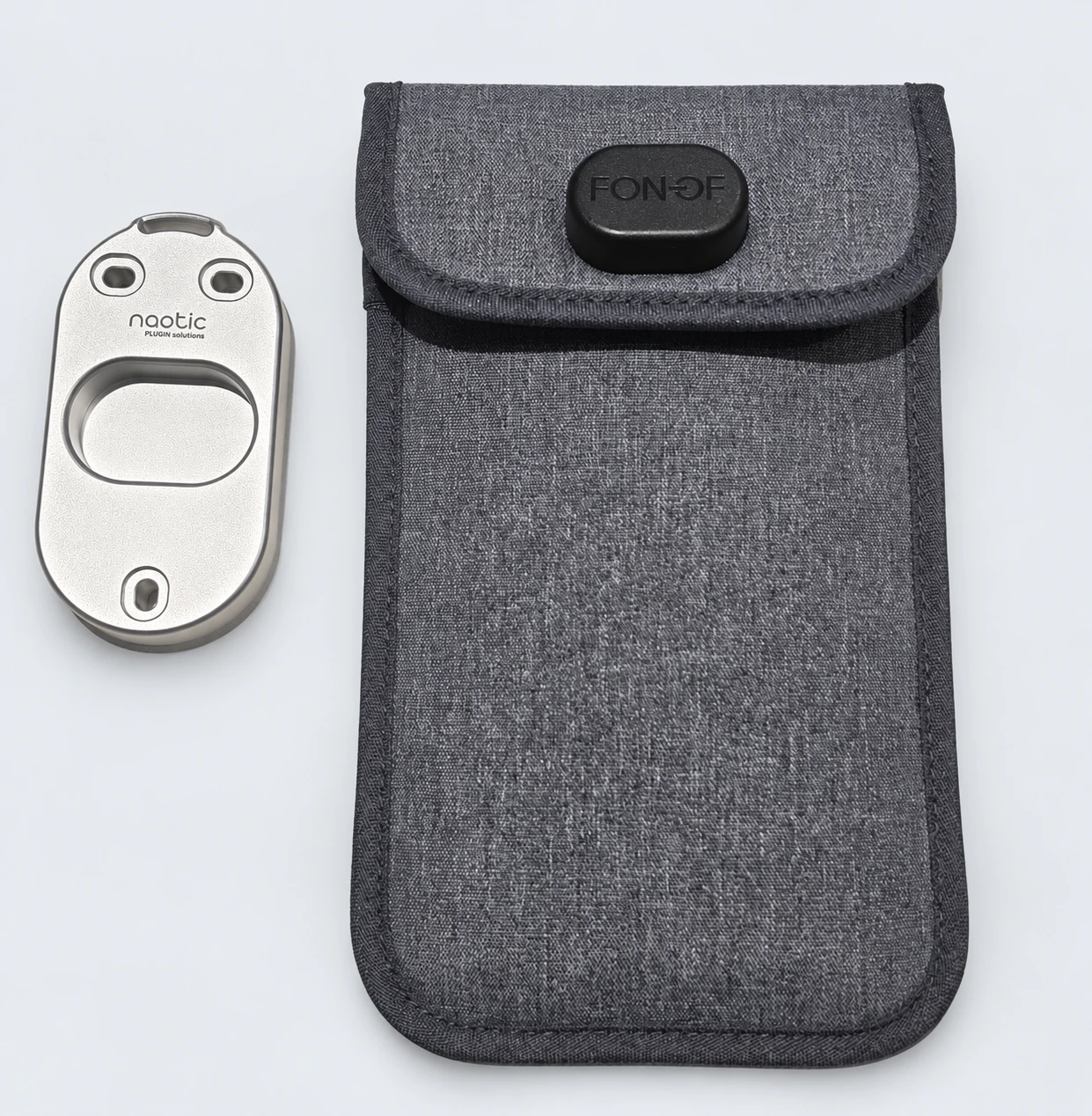
A pouch with a flap and secure closure without sharp components, opened with a FONOF base.
Designed to block the phone’s connections when it is correctly enclosed in the locked pouch.
Recycled R-PET polyester with a water-repellent finish, according to the manufacturer. This does not make it waterproof.
A transparent pocket for identifying the pouch and reducing mix-ups between students.
Lightweight, portable FONOF unlocker: supervisors can carry it in a pocket or on a neck lanyard. Together with the school, we define the number, location and responsible staff for portable units and unlocking points.
Insert the phone, fully close the flap and check the lock. Avoid forcing the mechanism. Report damage to the pouch or unlocking base to the designated person before continuing to use it.
View manufacturer featuresView how FONOF works
The warranty term and coverage for the pouch and unlocking base are subject to written confirmation from Naotic before contracting.
Photographs of our FONOF sample with retouched backgrounds and lighting. The two individual views of the unlocking device are supplier images. FONOF is a Naotic product integrated into the CELOUT program.
Supplier examples featuring the Andalucía and Comunidad de Madrid identities. They are not presented as CELOUT clients or partners. Available options depend on the agreed proposal.
Enlarge image
Enlarge image
OUR PROGRAM
CELOUT organizes implementation with your school: supply, preparation of the school community and support. Each proposal defines quantities, activities, responsibilities and a timeline.
We agree on participating students, the plan, scope and timeline. The proposal and contract set out supply and service terms.
We coordinate pouches and unlocking bases according to availability or the import schedule in the selected plan.
We define responsible staff, schedules and communication channels. Together with the school, we plan unlocking points in safety assembly areas, with unlockers in locked or secured boxes, and portable units for supervisors. Their location, access and use are integrated into the school’s emergency plan and drills.
We explain how the pouch works, who keeps the phone and how to contact the school during the day.
We demonstrate locking and opening, the daily routine and how designated staff should handle incidents.
We give practical guidance on pouch use and care, schedules and the agreed rules.
We organize pouch identification and distribution, unlocking-base placement and operation checks.
We support the start according to the activities, channels and period set out in the proposal.
We collect the school’s observations and difficulties to agree on improvements to program operations.
The program includes these materials, adapted to the contracted scope and reviewed with the school before launch.
A starting text for the school to review and approve phone and pouch rules, schedules, exceptions and responsibilities.
Instructions for storing the phone, locking and opening the pouch, identifying it and reporting damage or faults.
An explanation of the program, launch schedule and school contact channels.
Support for introducing the program to teachers, staff and students.
Arrival and departure routines, authorized opening, emergencies and incidents.
A clear rule during the school day and an institutional channel for contacting their children. Advance information about schedules, the routine and accommodations.
More opportunities to focus and interact in person. They keep their phones and know when they can access them and whom to ask for help.
A shared routine for managing phone use, reducing opportunities for interruption and addressing difficulties with support from designated staff.
An organized program with communication for the community, clear responsibilities and follow-up to refine implementation.
These are program objectives, rather than testimonials or results from a CELOUT implementation.
Enquire for my schoolOTHER SECTORS
One system, different needs. We adapt FONOF pouches and the operating protocol for organisations that need to manage phone access during specific activities.
Universities, institutes and training centres.
Industrial visits and controlled-access spaces.
Institutional meetings and activities.
Environments requiring specific procedures.
Concerts, presentations and private gatherings.
Workshops, conferences and working sessions.
Without appropriate rules during the school day, phone use can lead to:
Our special pouch combines a security closure and signal blocking so students keep their phones without access to their use during the school day.
SCHOOL COMMUNITIES TAKING ACTION
School communities in the region have introduced agreements, campaigns and rules to manage phone use. Explore their reasons, proposed measures and documented follow-up.
Colombia · Agreement and follow-up
In 2024, UNCOLI’s 27 schools agreed to restrict mobile-device use during school hours and involve families. In 2025, the association published an initial study across 25 schools to document the initiative and guide their shared efforts.
UNCOLI · May 8, 2024 and October 16, 2025.
The follow-up reports initial results and associations; it does not by itself establish that restrictions caused the reported improvements.
Ecuador · School procedures
The guidelines published by Sánchez y Cifuentes seek to protect learning and school life. They define restrictions, exceptions, device custody and institutional communication channels for families, with planned outreach and follow-up.
Unidad Educativa Sánchez y Cifuentes · Document consulted on October 2, 2026.
Document linked from the school’s website. It has no identified approval date or version number; its internal validity and implementation results have not been confirmed.
Chile · Institutional campaign
Chile’s Ministry of Education introduced Modo Aula alongside guidance for regulating mobile devices. The campaign encourages attention and human connection, involving families in school agreements and procedures that allow for exceptions.
Chile’s Ministry of Education · February 18, 2026.
The campaign and its guidance are not an evaluation of outcomes and do not create obligations for Ecuador.
Summaries written by CELOUT. The sources retain authorship of their content. Inclusion does not imply a commercial relationship or endorsement of CELOUT. Links open the original source in a new tab.
FREQUENTLY ASKED QUESTIONS
Collecting phones is not required as part of the routine: each student keeps their phone inside the closed pouch. The school supervises its use and handles incidents.
The school defines schedules, unlocking points and staff responsibilities. Pouches are opened with the FONOF unlocker at the agreed times.
The school emergency plan comes first; unlocking a pouch must never delay evacuation. Strategic unlocking points and staff carrying portable unlockers in a pocket or on a neck cord are agreed in advance.
The school communicates its contact channels before the programme starts. If a family needs to reach a student, school staff facilitate contact according to the situation.
The school agrees an exception before launch and defines how phone access will be provided. Accessibility needs are also considered, respecting student privacy.
The appointed staff member contacts CELOUT to arrange a review. The commercial proposal specifies the support procedure and warranty conditions.
CONTACT AND PARTNERSHIPS
Tell us how many students would participate and what your school needs. We will prepare a proposal for your leadership team.
OPERATING BASE
Ecuador